Key takeaways
-
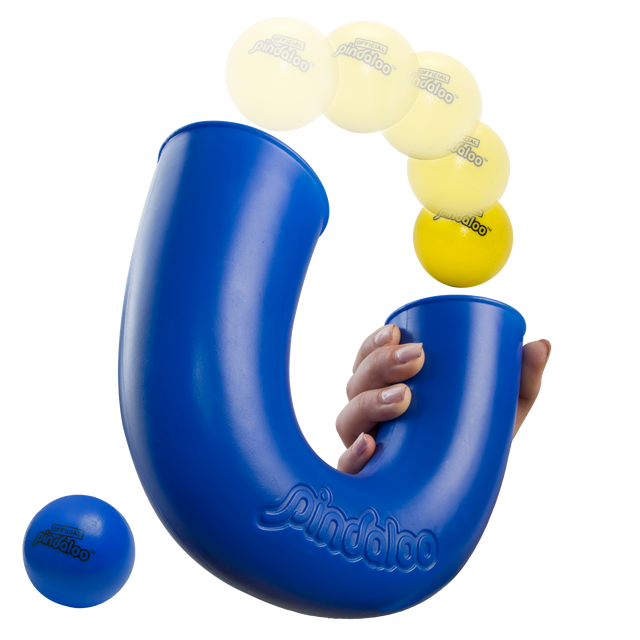
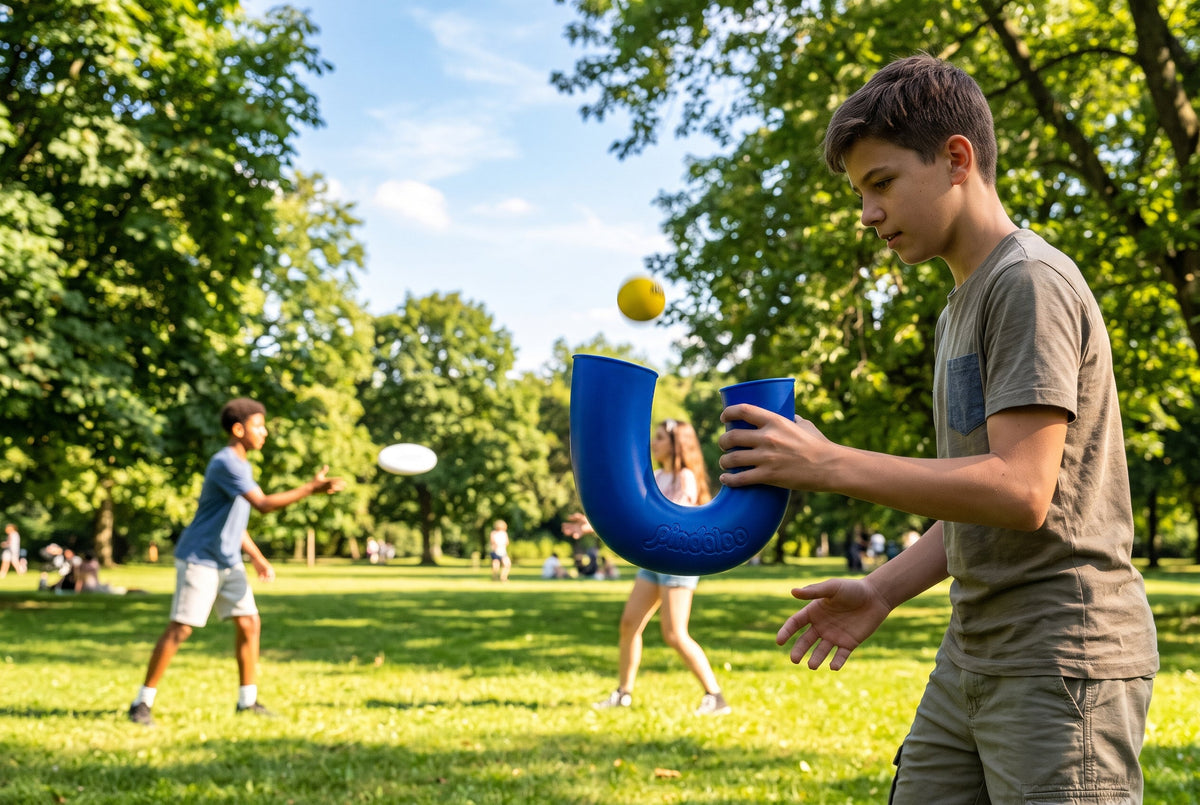
A frisbee is a flying disc you throw to a partner; a Pindaloo is a precisely designed curved tube you hold in one hand to loop a ball and catch it again.
-
The frisbee wins on distance and open-field fun, from casual catch to team sports like ultimate and disc golf.
-
The Pindaloo wins on flexibility: it works solo, in a small space, on windy days and even in the pool.
-
They train different things: a frisbee asks for throwing accuracy and running; the Pindaloo requires fast decision-making and hand-eye coordination in a tight, quick loop.
-
Many families keep both: the frisbee for the park, the Pindaloo ($31.90 as of October 2026) for everywhere else.
Both games are about the same simple pleasure: sending something into the air and catching it. But a frisbee and a Pindaloo feel very different once you play them. One needs a field and a partner; the other fits in your backpack and works on your own. This guide compares the Pindaloo and the frisbee side by side, on how they are played, where they work best, who they suit and what skills they ask for, so you can pick the right one for your next outing or buy both with a clear idea of when to use each. If you have never tried a Pindaloo, start with our quick guide on how to play Pindaloo.
Disclosure: this guide is published by Pindaloo, the maker of the Pindaloo. We do not make or sell frisbees or flying discs.
Pindaloo vs frisbee at a glance
|
Pindaloo |
Frisbee |
|
|---|---|---|
|
What it is |
A precisely designed curved tube and a ball |
A flying disc |
|
How you play |
Flip the ball out of one end, loop it over the top, catch it back inside |
Throw the disc to a partner, who catches and throws it back |
|
Players |
Solo or with friends |
At least two for catch; teams for ultimate |
|
Space needed |
Small: yard, patio, beach, room with a clear space |
Large: park, field or beach |
|
Wind |
Little effect, the loop stays close |
Wind can carry the disc away |
|
Water |
Made of durable, waterproof materials, works in the pool |
Depends on the model |
|
Scoring |
Count loops; named tricks; Guinness records |
Casual, or formal in ultimate and disc golf |
|
Main skills |
Fast decision-making, hand-eye coordination, wrist control |
Throwing accuracy, reading flight, running |
|
Ages |
Rated 9 and up |
Varies by disc and sport |
How each game is played
Frisbee: you grip the edge of the disc, snap your wrist and send it spinning to a partner. The spin keeps it stable in the air, and your partner reads its flight and catches it. The longer the throw, the more space you need. Organized versions include ultimate, a team sport where players pass the disc toward an end zone, and disc golf, where players throw discs into elevated baskets around a course.
Pindaloo: you hold the tube in one hand. A quick flick sends the ball out of one end, over the top in a loop, and back into the tube. Each catch is one loop. Once the basic loop is consistent, players work on long streaks, speed rounds and named tricks from the official Pindaloo tricks library, from Crossbow and Recall to Sidekick and Turbo.
Where each one works best
The frisbee is made for open space. A park, a field or a wide beach on a calm day is ideal. In a small yard, throws quickly end in a hedge or on a roof, and on a windy day the disc goes where the wind wants.
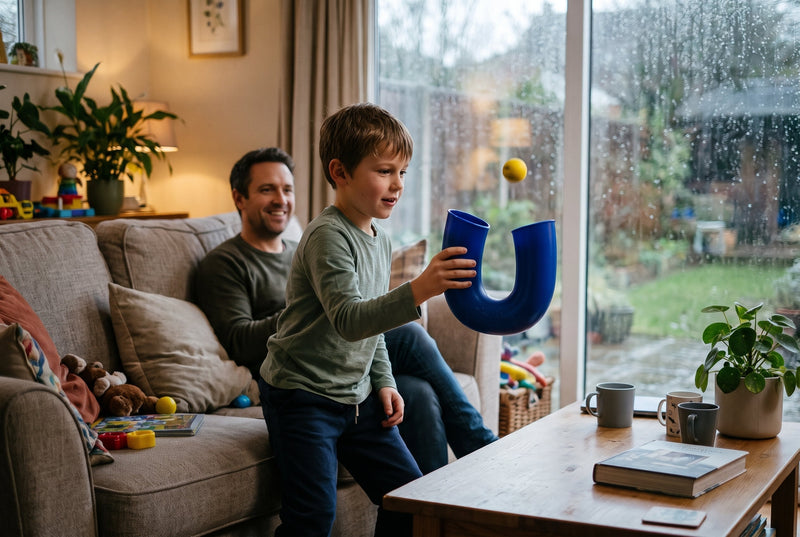
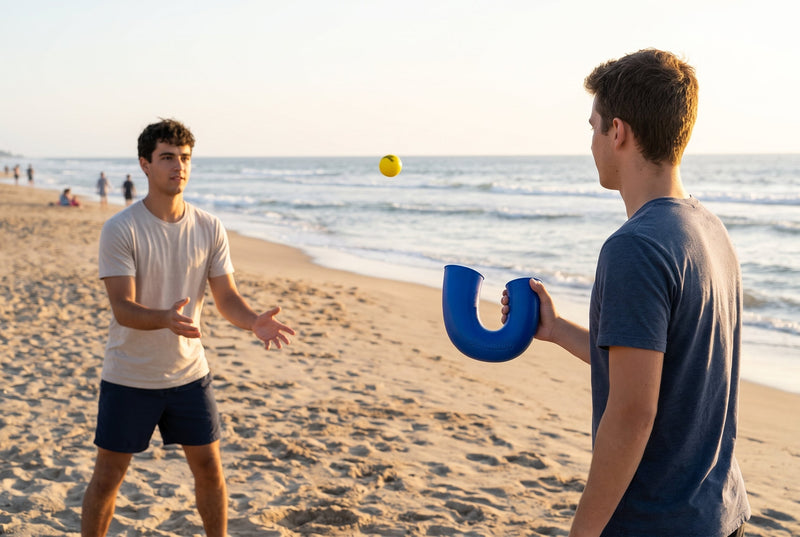
The Pindaloo works almost anywhere. Because the ball loops just above your hand, a small yard, a patio, a campground or a room with a clear space is enough. Wind has little effect, and since it is made of durable, waterproof materials, it even works in the pool. For indoor play, choose a space away from breakables and play over a rug.
Solo play vs social play
A frisbee is social by nature: you need someone to catch. That is a big plus for families and groups, but it means a frisbee often stays in the closet when no one is around to play.
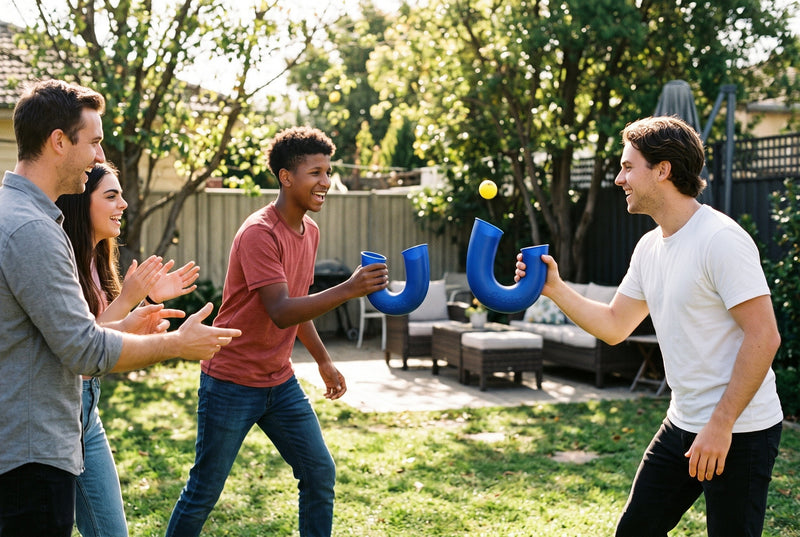
The Pindaloo works both ways. Alone, you chase your own best streak. With friends, it turns into a contest: who can land the longest streak, or the most loops in 30 seconds? Guinness World Records even tracks the official marks, with 2,109 consecutive loops as the endurance record and 64 loops in 30 seconds as the speed record.
Skills: what each game asks of you
|
Skill |
Pindaloo |
Frisbee |
|---|---|---|
|
Hand-eye coordination |
Constant, in a fast, tight loop |
On each catch |
|
Decision-making speed |
Fast: the ball returns in a split second |
Moderate: time to read the flight |
|
Throwing technique |
Small wrist flick |
Full arm and wrist throw |
|
Running and movement |
Small steps to stay under the ball |
Lots of running in open play |
|
Tricks and progression |
Named tricks, loop counts, records |
Trick throws and catches, team sports |
The Pindaloo requires fast decision-making and hand-eye coordination, because the ball comes back so quickly. That fast pace is part of why athletes enjoy it: the official NHL YouTube channel published a video of NHL players playing Pindaloo in October 2026. A frisbee gives you more time to read each throw but asks for more running, which makes it a great full-body game in a big space.
Which one should you choose?
|
If you want... |
Choose |
|---|---|
|
A game for a big park on a calm day |
Frisbee |
|
A team sport |
Frisbee (ultimate, disc golf) |
|
A game you can play alone |
Pindaloo |
|
Something for a small yard or patio |
Pindaloo |
|
A game for windy days |
Pindaloo |
|
A pool or beach game |
Pindaloo, or a disc that floats |
|
Tricks and records to chase |
Pindaloo |
|
A gift for a child 9 or older |
Pindaloo, or both |
Many families end up with both: a frisbee in the car for park days and a Pindaloo in the backpack for everywhere else. For more ideas, see our guide to the best frisbee alternatives.
Our pick for everyday play: Pindaloo
For a game you will actually use every day, we recommend the Pindaloo. It needs no partner, no field and no calm weather, so it comes out far more often than a disc. The blue Pindaloo juggling skill game costs $31.90 as of October 2026, comes with two balls and is rated for ages 9 and up. For evening play, glow-in-the-dark LED balls keep the ball visible after sunset.
FAQ
What is the difference between a Pindaloo and a frisbee?
A frisbee is a flying disc you throw to a partner, who catches it and throws it back, so it needs open space and at least two players. A Pindaloo is a precisely designed curved tube held in one hand: you flip a ball out of one end, it loops over the top and you catch it back inside. That means you can play alone, in a small space and in the wind. Both are throw-and-catch games, but the Pindaloo is faster and more compact, while the frisbee covers more distance.
Is the Pindaloo harder than a frisbee?
They are hard in different ways. A basic frisbee throw takes practice to make it fly straight, and catching asks you to read the disc's flight. With the Pindaloo, the basic loop is quick to learn for many people, but the ball returns so fast that long streaks and tricks take real practice. A review on What's Good To Do reported learning the basic Pindaloo loop in about five minutes, and the toughest official tricks, like Sidekick and Turbo, take much longer.
Can you play Pindaloo alone?
Yes. The Pindaloo is designed so you can play on your own: you throw and catch the ball yourself with one tube, and each catch counts as one loop. Solo players chase their best streak or their best score in 30 seconds and work through the official tricks. With friends, it becomes a competition. A frisbee, by contrast, needs at least one other player for a game of catch.
Which is better for kids, a frisbee or a Pindaloo?
Both are great for kids. A soft frisbee is a good choice for younger children and for families with a big park nearby, since it gets everyone running. The Pindaloo is rated for ages 9 and up and suits kids who like a personal challenge: it works in the yard, at the beach or in the pool, and the loop count gives them a score to beat every day. Many families keep both.
Does the Pindaloo work in the wind?
Yes, much better than a frisbee. A frisbee is light and flat, so wind can carry it far off course. With the Pindaloo, the ball makes a small, fast loop just above your hand, so wind has little effect on play. That makes it a good choice for breezy beach days and open campgrounds where a disc would be hard to control.
Throw, catch, repeat
The frisbee and the Pindaloo share the joy of throwing and catching, but they shine in different places. Take a frisbee to a big park on a calm day, and take a Pindaloo everywhere else: the yard, the beach, the pool and the living room. For a game that is always ready to play, grab a red Pindaloo juggling game and start counting loops.