Key takeaways
-
The best screen-free toys compete with screens on their own terms: instant feedback, a goal to beat and a reason to play again.
-
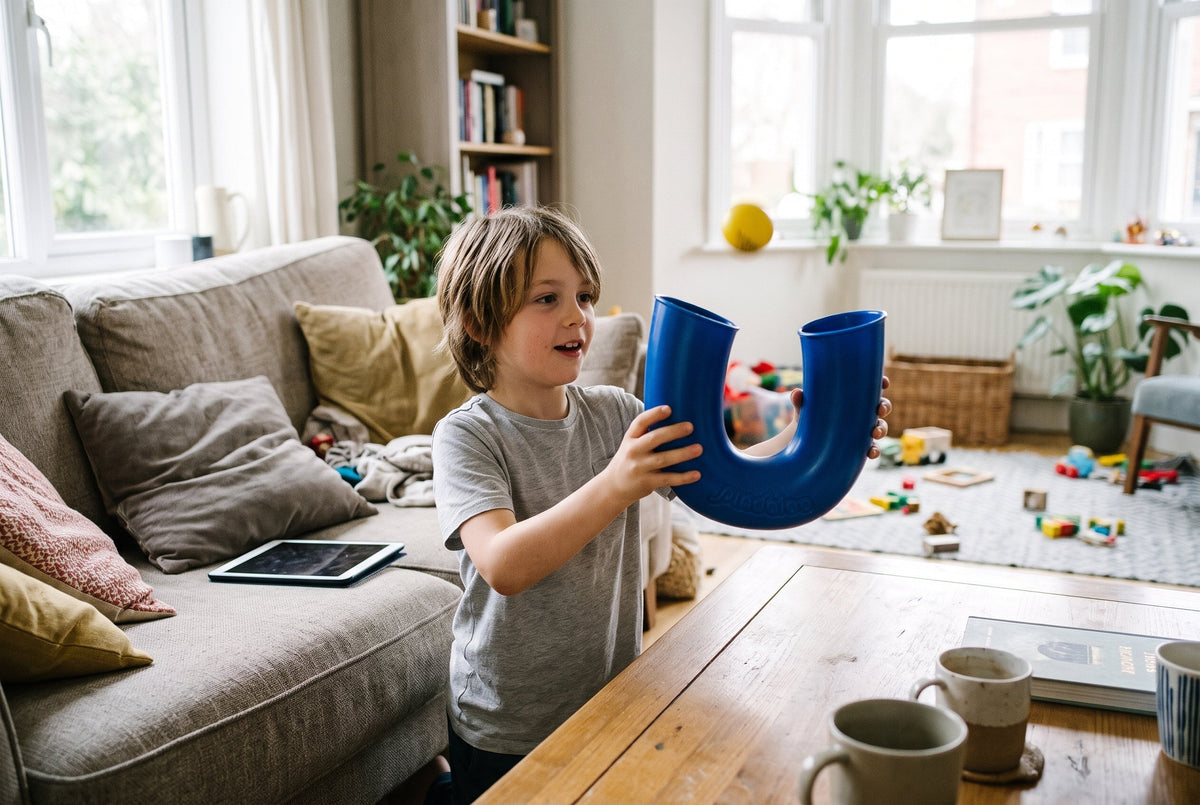
Our featured pick for ages 9 and up is the Pindaloo ($31.90 as of October 2026), a precisely designed curved tube where every loop is a point on the scoreboard, just like a game, but in the real world.
-
Mix four types: active toys, building toys, strategy games and creative toys cover every mood.
-
Play together when you can: the American Academy of Pediatrics notes that traditional toys that bring parents and kids together support interaction better than digital toys.
-
Make them easy to grab: a screen-free toy on a high shelf loses to a tablet on the couch.
Screens are designed to be hard to put down: bright, fast and full of rewards. Telling kids to "go play" rarely wins that fight. What does work is a toy that offers the same hooks in the real world: a quick win, a score to beat and a challenge that grows. This guide rounds up 16 real, widely available screen-free toys that do exactly that, sorted by type and age. Our featured pick is the Pindaloo juggling skill game, created in 2012 with one clear mission: getting kids away from screens and into physical play.
Disclosure: Pindaloo publishes this guide and makes the Pindaloo and Qubic4. Every other toy is a well-known product or toy type we do not sell.
What makes a screen-free toy kids actually play with?
A screen-free toy wins attention when it borrows what screens do well: fast feedback, clear goals and visible progress. Without those, even a great toy ends up in a closet.
|
What screens offer |
The screen-free version |
Example |
|---|---|---|
|
Instant rewards |
A catch, a click, a finished build |
Pindaloo, Magna-Tiles |
|
Scores and levels |
Loop counts, puzzle levels, tricks |
Pindaloo, Rush Hour |
|
Social play |
Games against friends and family |
Qubic4, Uno |
|
Endless novelty |
Open-ended toys with new results every time |
LEGO, art supplies |
|
Always available |
Toys kept within easy reach |
Any toy on a low shelf |
There is research behind playing together, too. In a 2019 clinical report, the American Academy of Pediatrics noted that traditional toys that encourage interaction between parents and children support play and interaction better than digital toys (Healey et al., Pediatrics, 2019).
Screen-free toys at a glance
|
Toy |
Type |
Ages |
Plays with |
|---|---|---|---|
|
Pindaloo (our pick) |
Active skill game |
9+ |
Solo or group |
|
Jump rope |
Active |
School age |
Solo or group |
|
Stomp Rocket |
Active |
Preschool and up |
Solo or group |
|
Kendama |
Active skill toy |
School age and up |
Solo |
|
Magna-Tiles |
Building |
Preschool and up |
Solo or group |
|
LEGO Classic |
Building |
Check box |
Solo or group |
|
GraviTrax |
Building |
Check box |
Solo |
|
Qubic4 (our pick) |
Strategy |
Check product page |
2 players |
|
Uno |
Card game |
School age |
2 to 10 |
|
ThinkFun Rush Hour |
Logic puzzle |
Check box |
Solo |
|
Jigsaw puzzles |
Puzzle |
All ages |
Solo or group |
|
Play-Doh |
Creative |
Preschool and up |
Solo or group |
|
Art supply kit |
Creative |
All ages |
Solo |
|
Klutz activity kits |
Creative |
Check box |
Solo or small group |
|
Audiobook player for kids |
Listening |
Check box |
Solo |
|
Books and graphic novels |
Reading |
All ages |
Solo |
Our featured pick: Pindaloo
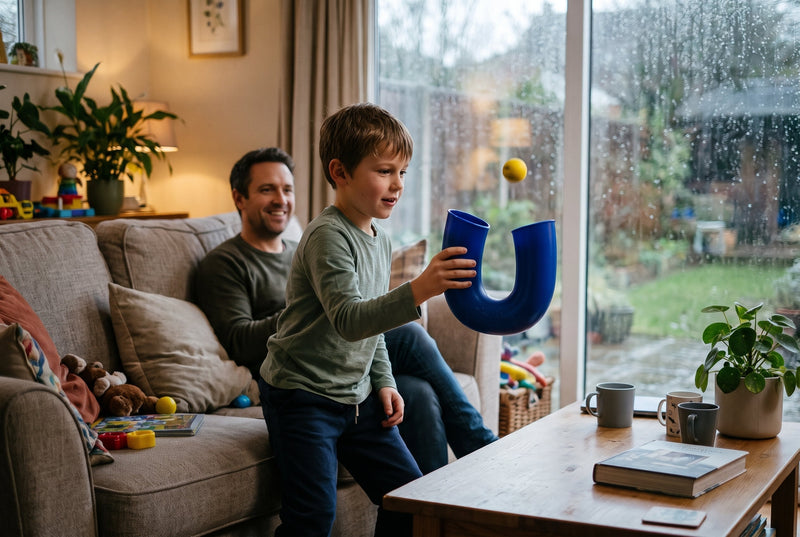
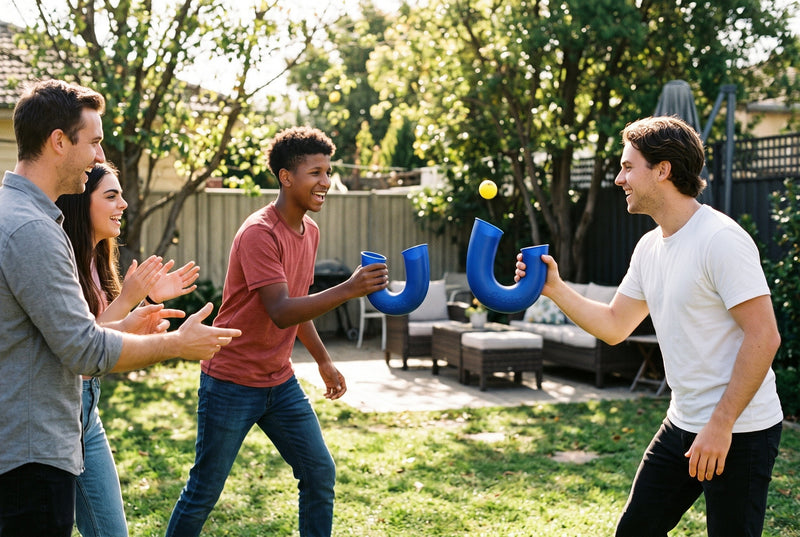
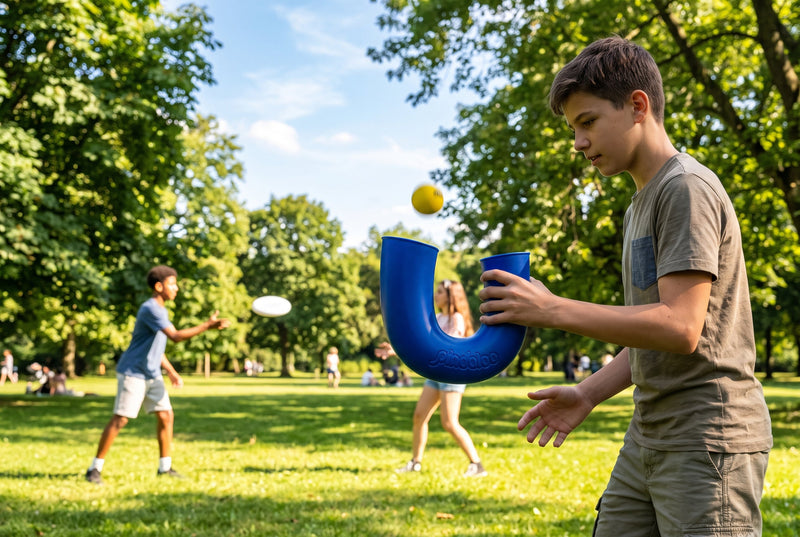
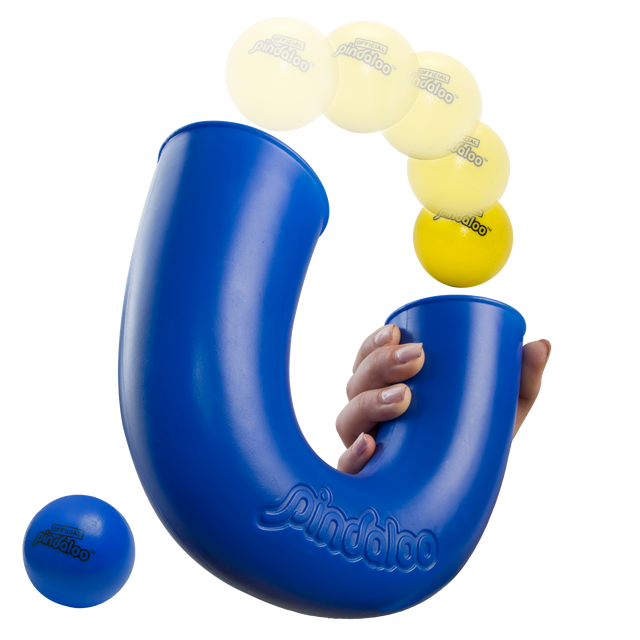
The Pindaloo is our favorite screen-free toy for kids 9 and up because it gives them what games on a screen do: a score, a challenge and a reason to try "just one more time." It is a precisely designed curved tube held in one hand. You flip a ball out of one end, it loops over the top, and you catch it back inside. Every catch is one loop, so the score climbs in real time.
It was designed for this exact problem. Inventors Amir Zobel and Matan Shamir created the Pindaloo in 2012 during a Master's degree project to get kids away from screens and into physical play. The game requires fast decision-making and constant hand-eye coordination, so it holds attention the way a good video game does. And it has a leaderboard: Guinness World Records lists the most consecutive loops of a ball with a Pindaloo at 2,109.
The blue Pindaloo juggling skill game costs $31.90 as of October 2026. It needs no batteries in its classic version and is made of durable, waterproof materials, so it works indoors, outdoors and in the pool.
Active screen-free toys
Active toys replace screen time with moving time. The CDC recommends 60 minutes or more of moderate-to-vigorous physical activity a day for kids ages 6 to 17 (CDC).
1. Pindaloo
The Pindaloo works in short bursts, which is exactly when kids reach for a screen: after school, before dinner, during a break. A loop record on the fridge keeps the challenge going.
2. Jump rope
A jump rope is cheap, portable and endlessly challenging, from simple skips to crossovers and double unders. Count jumps in a row to turn it into a game.
3. Stomp Rocket
Stomp Rocket launches foam rockets high into the air when kids stomp on an air pad. It is a great outdoor toy for younger kids with lots of energy.
4. Kendama
A kendama is a Japanese skill toy with cups, a spike and a ball on a string. With hundreds of named tricks, it has the same "next level" pull as a video game.
Building screen-free toys
Building toys keep hands busy and give kids something to show at the end.
5. Magna-Tiles
Magna-Tiles are magnetic tiles that snap together into towers, houses and garages. They are quick to build with, which suits kids who want results fast.
6. LEGO Classic
A LEGO Classic box of mixed bricks invites free building rather than following one model. It grows with kids from simple houses to complex creations.
7. GraviTrax
GraviTrax by Ravensburger is a marble run system where kids design tracks using gravity and magnets. Testing and fixing the run is half the fun.
Strategy and puzzle screen-free toys
Games and puzzles replace screen challenges with real ones, often around the family table.
8. Qubic4
Qubic4 takes four-in-a-row into 3D with wooden cubes. Each player has a set of 32 pieces and wins with a line horizontally, vertically or diagonally while blocking the other. It is a quick, two-player duel that parents and kids can play on equal terms. The Qubic4 3D board game is on sale for $25.90 as of October 2026.
9. Uno
Uno is a fast card game where players match colors and numbers and try to empty their hand first. It plays with 2 to 10 people, which makes it a family favorite.
10. ThinkFun Rush Hour
Rush Hour is a sliding-block logic puzzle: move the cars to free the red car. Challenge cards go from beginner to expert, like levels in a game.
11. Jigsaw puzzles
A jigsaw puzzle is a calm, shared project. Leave one out on a table and family members will add pieces all week.
Creative screen-free toys
Creative toys swap watching for making.
12. Play-Doh
Play-Doh is a classic modeling compound that younger kids can shape, cut and squish for hours. Tool sets add new ideas.
13. Art supply kit
A good art kit with markers, colored pencils and a sketchbook invites kids to draw their own characters and comics, instead of watching someone else's.
14. Klutz activity kits
Klutz kits include a full instruction book and materials for a project, from paper airplanes to sewing. They are good for a rainy afternoon.
Listening and reading screen-free toys
Stories do not need a screen.
15. Audiobook player for kids
Screen-free audio players for kids play stories and music using cards or figures, with no display. They are popular for quiet time and car rides.
16. Books and graphic novels
Graphic novels like Dog Man or Amulet hook reluctant readers with art and humor. A trip to the library is the cheapest screen-free toy there is.
How to make screen-free toys win
The toy is only half the battle; the setup matters too. Keep screen-free toys visible and within reach, ideally in the room where screens usually win. Play with your kids at first, since a parent joining in is the fastest way to make a toy interesting. Add a challenge, like a loop record board for the Pindaloo or a weekly Qubic4 tournament. And rotate toys, putting some away for a few weeks so they feel new again. For outdoor evenings, glow-in-the-dark LED balls turn the Pindaloo into a night game.
FAQ
What are good screen-free toys?
Good screen-free toys offer quick feedback, a clear goal and room to grow. Active toys like the Pindaloo, jump ropes and kendamas, building toys like Magna-Tiles, LEGO and GraviTrax, strategy games like Qubic4 and Uno, puzzles like Rush Hour, and creative toys like art kits and Play-Doh all fit. The Pindaloo is a strong choice for kids 9 and up because it works like a game on a screen, with a score that climbs with every loop, but it gets kids moving instead of sitting.
How do I get my child off screens?
To get a child off screens, offer something that is just as engaging, not just a rule. Toys with scores and levels, like the Pindaloo's loop count or Rush Hour's challenge cards, compete well with screens. Keep those toys within easy reach, play with your child at first and set up small challenges like family records. Clear routines help too, such as screen-free time after school or before bed. If you have concerns about your child's screen use, your pediatrician can help you build a family media plan.
What are screen-free toys for 9-year-olds?
Good screen-free toys for 9-year-olds include the Pindaloo, which is rated for ages 9 and up, kendamas and jump ropes for active play, GraviTrax and LEGO for building, Qubic4 and Uno for games, Rush Hour for puzzles and graphic novels for reading. At nine, many kids want to master a skill and show it off, so toys with tricks, levels or records work especially well. The Pindaloo's loop count and named tricks give them exactly that.
Are screen-free toys better than educational apps?
Screen-free toys and educational apps do different things, but for young children, the American Academy of Pediatrics notes that traditional toys that bring parents and kids together support play and interaction better than digital toys. Screen-free toys also get kids moving and building with their hands. That does not mean every app is bad. A balanced approach works well: use apps thoughtfully, and make sure there are engaging screen-free toys, like a skill game or a strategy game, within easy reach.
What screen-free toys work for the whole family?
Screen-free toys that work for the whole family are easy to learn but hard to master, so kids and adults compete on equal terms. The Pindaloo is a great example: everyone from 9 up can try it, and a family loop record keeps the competition going. Qubic4, Uno and jigsaw puzzles are other family favorites. Family toys work best when parents join in, so set aside a regular time, like after dinner, for a quick game together.
Give them something better than a screen
The best screen-free toys do not fight screens with rules: they win with fun. Pick toys that offer a quick win, a score to beat and a reason to play again, then keep them within reach and play along. For kids 9 and up, the Pindaloo was designed for exactly this job. Pick up a red Pindaloo juggling game and start a screen-free family record tonight.